

FUSION SYSTEMS
Commercial Fusion Requires More Than Creating Plasma
Seed IQ™ Brings Continuous, Asdaptive Execution Control to Plasma Stability
Adaptive Execution Intelligence for Fusion Systems
Overview
Fusion plasma is an extraordinarily dynamic physical system. Conditions evolve continuously, multiple variables interact at once, and loss of stability can rapidly move a reactor outside its intended operating state.
Seed IQ™ is being applied to this challenge as an adaptive execution control layer.
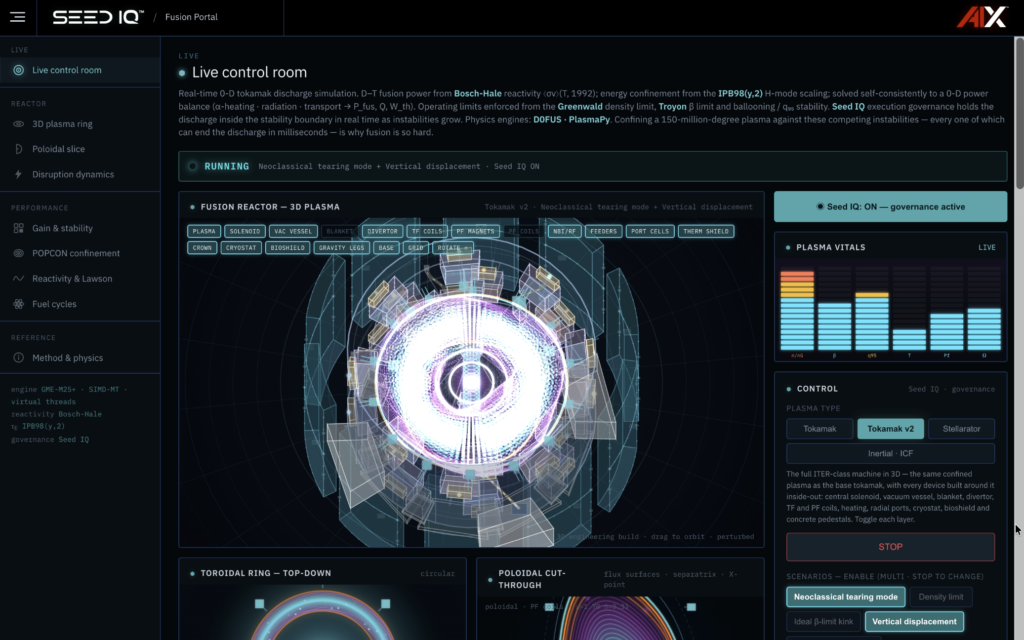
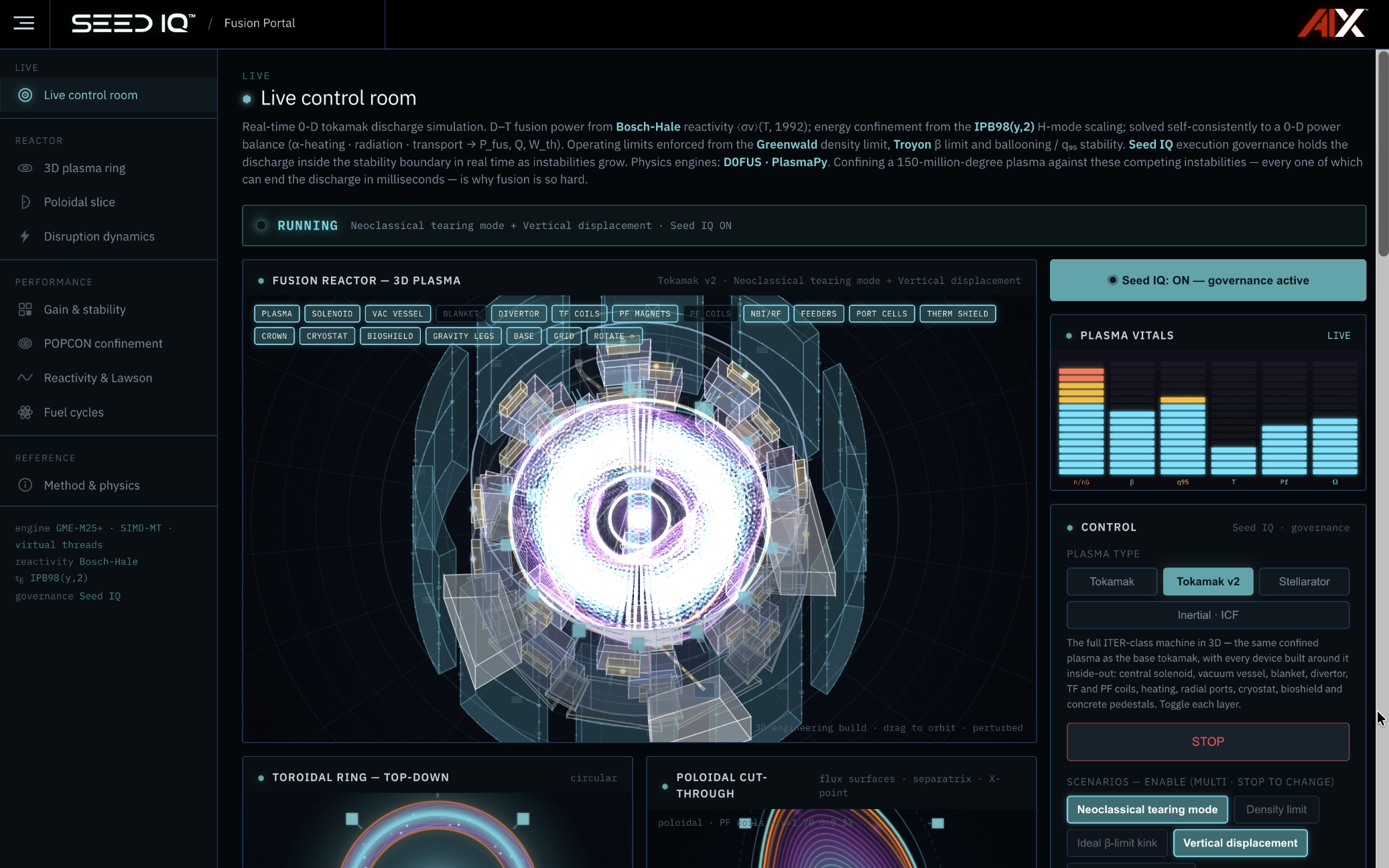
Through the AIX Fusion Portal, Seed IQ connects to scientific fusion reactor simulations, continuously observes changing plasma conditions, identifies developing instability, and executes corrective control actions as the system evolves.
Rather than treating plasma stability as a sequence of isolated corrections, Seed IQ operates as a continuous closed-loop process:
Sense → Assess → Act → Observe → Adapt
The objective is to keep the evolving system within viable operating conditions as circumstances change.
Current stage: This work is simulation-based. Seed IQ has not yet been deployed to control plasma in a physical fusion reactor.
The Seed IQ™ Tokamak Simulator
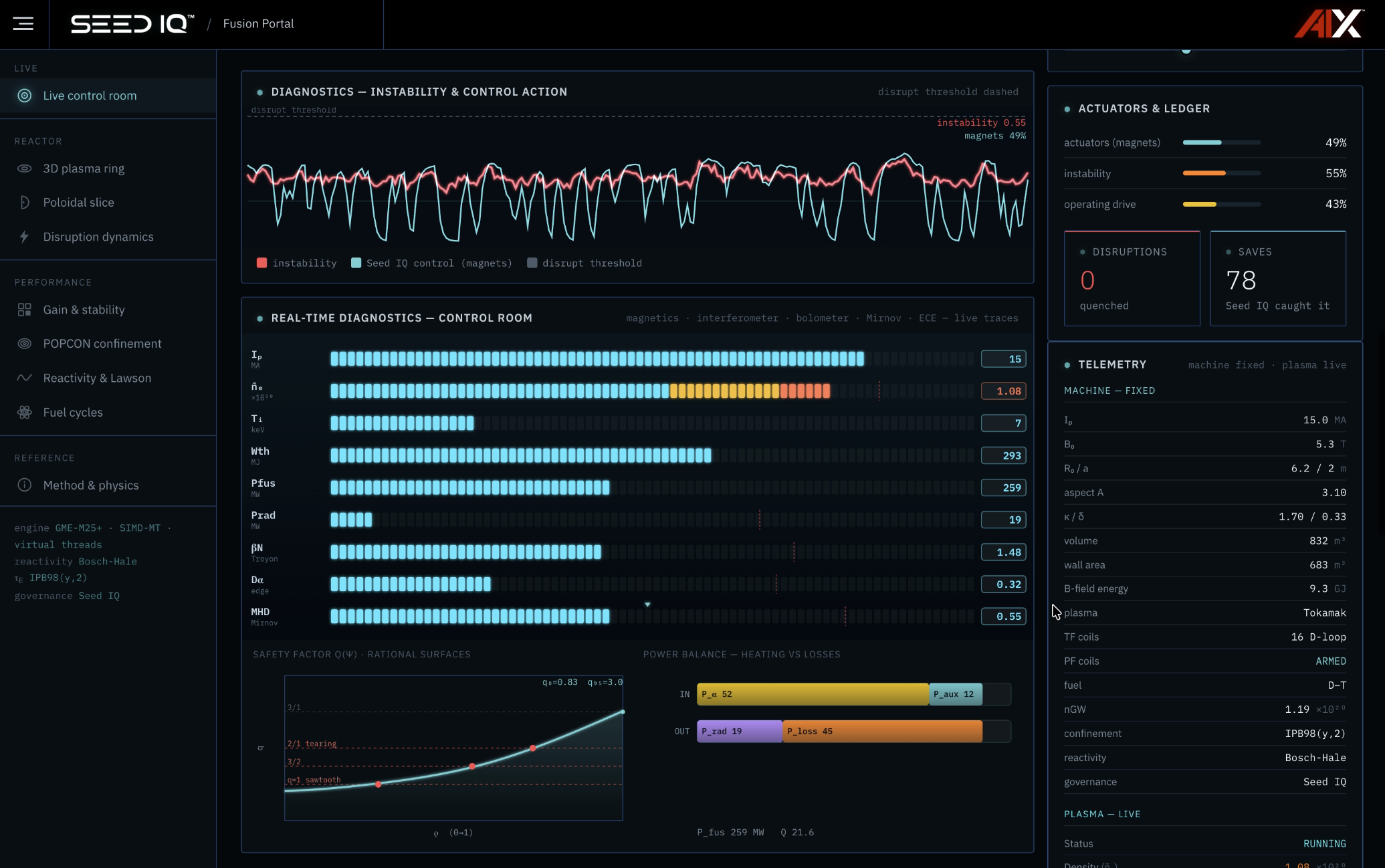
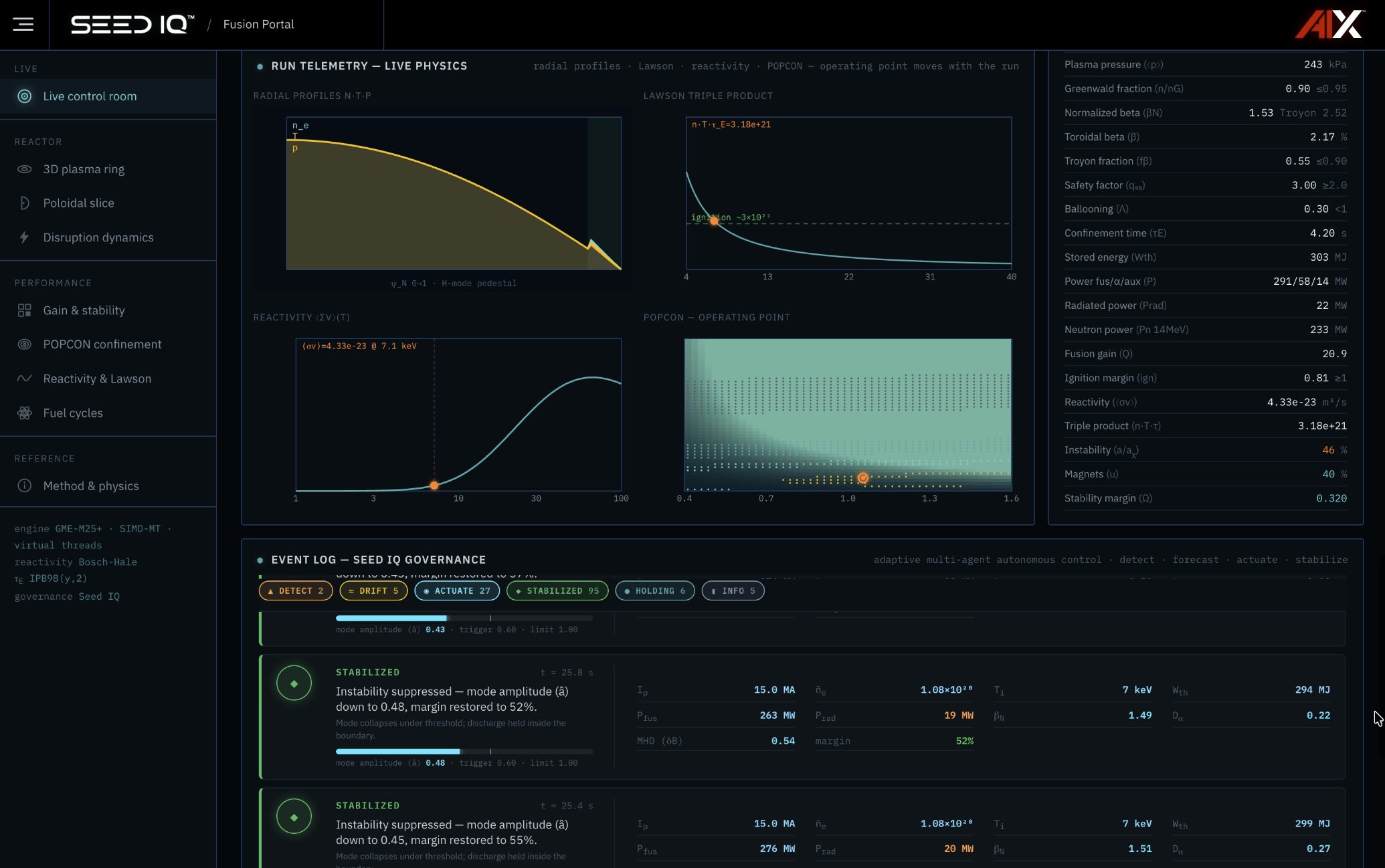
The Seed IQ Tokamak Simulator is a full interactive reduced-order fusion physics environment designed to model, stress, and stabilize a live D-T tokamak discharge in real time. The simulator couples Bosch-Hale fusion reactivity, IPB98(y,2) H-mode energy confinement, alpha heating, radiation, transport losses, stored thermal energy, fusion gain, and Lawson triple-product behavior into a self-consistent 0-D power-balance model, while simultaneously enforcing major operational boundaries including the Greenwald density limit, Troyon normalized-beta limit, q95, ballooning stability, radiation limits, and related plasma constraints.
It includes physically distinct disruption scenarios such as neoclassical tearing modes, density-limit collapse, ideal β-limit kinks, vertical displacement events, and Type-I ELM/pedestal instabilities, each connected to an appropriate actuator such as ECCD current drive, density pump-out, auxiliary-power throttling, vertical-stability coils, or resonant magnetic perturbations.
Seed IQ operates as the active execution-governance and stabilization layer: it monitors instability growth, detects and forecasts approaches to stability boundaries, commands actuators, drives the effective mode growth rate negative, suppresses developing instabilities, and restores operating margin before disruption.
With governance disabled, unstable modes can grow through their critical boundary and produce a modeled thermal or current quench; with Seed IQ active, the same disturbances can be detected, actuated against, and recorded as successful stabilization events.
The result is not simply a visualization of a tokamak, but a live fusion-control laboratory where plasma physics, operating limits, instability dynamics, diagnostics, actuator behavior, and autonomous Seed IQ control can be explored together in one continuously evolving simulation.
Creating fusion conditions is only part of the problem.
The Problem: Plasma Stability Is a Continuous Control Challenge
The Solution: Adaptive Plasma Execution Governance
The control problem is continuous
Instability can emerge from interactions across the system rather than from a single isolated variable. In magnetic-confinement systems, plasma disruptions can result in loss of confinement, extreme thermal loading, mechanical stress, component damage, and reduced operating time.
Seed IQ™ continuously evaluates the evolving system state rather than relying on a single prediction or predetermined response.
In the current tokamak demonstration, corrective magnetic actions are triggered dynamically as Seed IQ detects developing instability.
Those conditions must be controlled while plasma behavior, position, temperature, density, magnetic conditions, and other operating variables continue to change.
Detect meaningful changes while they are developing
Distinguish normal variation from movement toward instability
Determine when intervention is required
Select and execute an appropriate corrective action
Evaluate how the system responds
Continue adapting as the state changes again
Within the current fusion simulation environment, Seed IQ:
- Observes plasma telemetry continuously
- Detects movement toward unstable operating conditions
- Evaluates when corrective intervention is required
- Executes control actions through the simulated reactor control environment
- Measures the resulting change in system state
- Continues adjusting as new conditions emerge
Fusion is not governed once.
It must remain governable throughout execution.
Seed IQ™ intervention does not happen once.
The system continually senses, acts, observes the response, and determines what is required next.
Continuous Adaptive Control
- SENSE Observe changing plasma telemetry and operating conditions. ↓
- ASSESS Evaluate the evolving state and identify movement toward instability. ↓
- ACT Trigger corrective control when intervention is required. ↓
- OBSERVE Measure how the plasma responds to that intervention. ↓
- ADAPT Update the control response as conditions continue to change.
- Then repeat.
This is adaptive execution under continuously changing physical conditions.
How it works
One Control Architecture Across Multiple Fusion Approaches
Seed IQ is not being developed around a single reactor architecture.
The current Fusion Portal is exercising the Seed IQ control architecture across scientific simulation environments representing multiple approaches to fusion:
Tokamak
Magnetically confined plasma in a toroidal reactor configuration.
Seed IQ continuously monitors plasma behavior and applies simulated magnetic corrective action as instability develops.
Stellarator
A different magnetic-confinement architecture with different plasma geometry and control characteristics.
Seed IQ is being applied to the changing system state through the same underlying adaptive execution architecture.
Inertial Confinement Fusion
A fundamentally different approach to producing fusion conditions, creating a distinct control environment.
Applying Seed IQ across different fusion simulation architectures helps test a larger premise:
the control architecture can remain consistent even when the physical system changes.
Designed for Increasing Complexity
Fusion instability rarely exists as a single clean event.
Conditions can compound.
The Fusion Portal enables increasingly difficult simulated conditions to be introduced together while Seed IQ continues evaluating and responding to the evolving system.
This provides a pathway for testing control behavior across progressively more demanding scenarios rather than demonstrating performance only under ideal conditions.
The goal is not simply to stabilize one predetermined event.
The goal is adaptive control when the system does not remain predictable.
For commercial fusion, technical performance and economic performance ultimately converge.
A power plant that can create fusion conditions but cannot sustain reliable operation cannot deliver consistent energy output.
Plasma disruptions can also impose costs beyond lost generation. In magnetic-confinement reactors, loss of confinement can expose reactor components to severe thermal and mechanical loads, potentially affecting component life, maintenance requirements, and operating availability.
Improved plasma control therefore has several potential economic pathways:
- Increased reactor availability
- Increased annual electricity production
- Reduced disruption-related downtime
- Reduced exposure to component damage
- Extended component operating life
- Reduced maintenance and recovery requirements
- Greater utilization of high-value reactor infrastructure
- More reliable commercial power delivery
The value is not simply in stabilizing plasma.
It is in what stable operation makes economically possible.
Illustrative Commercial-Scale Economics
At an illustrative wholesale electricity value of $70–$100/MWh, full annual generation represents approximately:
$613M–$876M
potential annual gross electricity value
At that scale:
$6.1M–$8.8M / year
gross electricity value associated with each additional 1 percentage point of plant availability
$30.7M–$43.8M / year
gross electricity value associated with a 5 percentage-point increase in plant availability
These figures illustrate the economic leverage associated with availability at commercial power-plant scale.
They do not represent measured Seed IQ performance improvements. Seed IQ has not yet been deployed on a physical fusion power plant, and no claim is being made that Seed IQ currently produces a particular increase in reactor availability.
The model demonstrates why even incremental improvements in future fusion reliability and availability could carry substantial economic value.
Control Technology Can Have Disproportionate Economic Leverage
A control layer does not need to represent a large percentage of reactor capital cost to create significant value.
If adaptive plasma control eventually improves availability, reduces damaging disruptions, extends component life, or improves utilization of a multi-billion-dollar fusion asset, the value created can substantially exceed the cost of the control technology itself.
This creates several potential sources of ROI:
More operating hours
Higher availability translates directly into additional energy production.
Greater asset utilization
More value can be generated from the same reactor infrastructure.
Component protection
Reducing damaging off-normal events may lower replacement and maintenance exposure.
Reduced downtime
Avoiding disruptions and improving recovery can increase productive operating time.
Improved operating confidence
More adaptive control may eventually support operation closer to high-performance boundaries while maintaining acceptable system conditions.
The commercial opportunity is therefore not limited to software efficiency.
It is leverage over the productivity of the underlying fusion asset.
Seed IQ™ Is Not a Fusion Reactor
Seed IQ™ is not another reactor design.
It is not a plasma simulator.
It is not a dashboard that simply visualizes reactor telemetry.
And it is not being developed solely as a disruption-prediction model.
Seed IQ™ is an adaptive execution layer designed to sit above existing systems, sensors, actuators, and operational data and
continuously govern execution as conditions change.
In fusion, that means perceiving the evolving plasma state and connecting perception directly to corrective action.
The reactor provides the physical system.
Sensors provide information about its state.
Actuators provide mechanisms for intervention.
Seed IQ™ governs the continuously changing execution between them.
From Simulation to Physical Fusion Systems
The current Fusion Portal establishes the simulation environment needed to develop, test, visualize, and demonstrate Seed IQ’s adaptive plasma-control capabilities.
The next progression is deeper validation with the fusion ecosystem:
Scientific simulation
- increasingly complex and high-fidelity reactor models
- fusion digital twins and hardware-in-the-loop environments
- collaboration with fusion laboratories and reactor developers
- experimental physical systems
- commercial reactor integration
AIX’s objective is not to build the fusion reactor.
It is to develop adaptive control infrastructure that can potentially make the reactors being built by others more stable, reliable, and commercially productive.
Stretegic Impact
Commercial fusion is rapidly moving from a predominantly scientific endeavor toward an industrial one.
That transition creates a new class of problems.
The question is no longer only whether fusion conditions can be produced.
It is increasingly:
Can those systems operate continuously, reliably, safely, and economically enough to become infrastructure?
That is an execution problem.
And execution is where Seed IQ operates.
Strategic Impact
If validated on physical fusion systems, adaptive plasma execution governance could create value across:
- Fusion reactor developers
- National and university fusion laboratories
- Commercial fusion power plants
- Reactor control-system providers
- Digital-twin and simulation environments
- Fusion research programs
- Energy infrastructure operators
Potential commercial models include reactor integration, enterprise licensing, recurring control infrastructure, simulation and validation programs, and performance-aligned commercial structures.
Seed IQ does not need to replace the reactor’s existing control architecture.
Its role is to add an adaptive layer capable of continuously governing execution across a complex and changing physical system.
From creating fusion conditions
to keeping them viable.
That is the control problem Seed IQ is being built to solve.

© 2026 AIX Global, inc. – All rights reserved
Seed IQ™ Intelligence + Quantum
Legal Counsel: Gunderson Dettmer