

QUANTUM COMPUTING
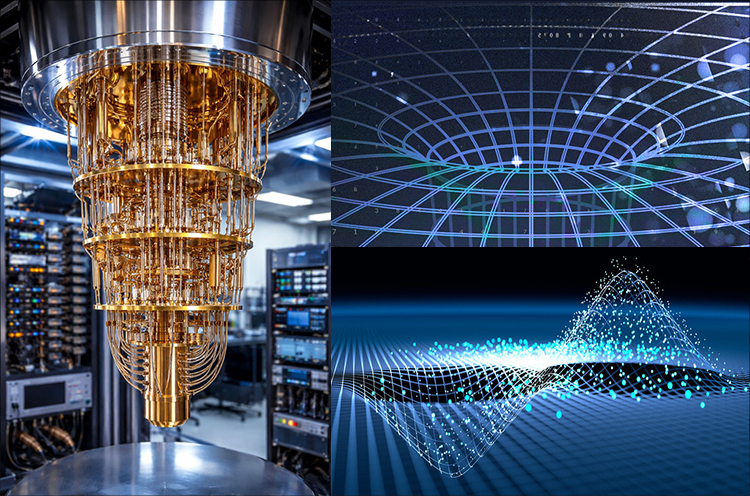
A Different Class of Quantum Intelligence is Emerging
Seed IQ™ converts runaway quantum execution costs into governed, scalable economics.
Quantum computing is one of the most unforgiving operational environments in existence. Noise is continuous. Failures are subtle. Costs are high. Small instabilities compound quickly, and by the time a breakdown becomes visible, recovery is often no longer possible.
Preliminary simulations using Seed IQ™, including IBM Qiskit and QuTiP-based quantum simulation experiments exploring barren plateaus, execution stability, and tail risk behavior, suggest that adaptive multi-agent autonomous control can actively govern quantum execution rather than merely react to it.
Seed IQ™ introduces safe halting as an explicit capability and the missing economic control layer in quantum computing. A failed VQE campaign commonly burns 20 to 100 QPU hours plus 20 to 40 hours of engineer time at roughly $150 per hour. When a run fails silently the effective loss commonly lands in the $10K to $50K range and can exceed $100K when recalibration and queue delays are involved.
Safe halting changes the economics completely. By stopping runs early when viability is lost Seed IQ™ reduces wasted QPU time, reduces wasted human time, and prevents invalid quantum outputs from entering pipelines. This directly converts uncontrolled spend into bounded predictable operating cost.
The impact compounds at scale. Organizations running hundreds of quantum experiments per year can eliminate millions of dollars in wasted execution. More importantly teams can run pipelines unattended because failures no longer require manual detection after the fact. This unlocks automation reliability and trust which are prerequisites for any serious deployment.
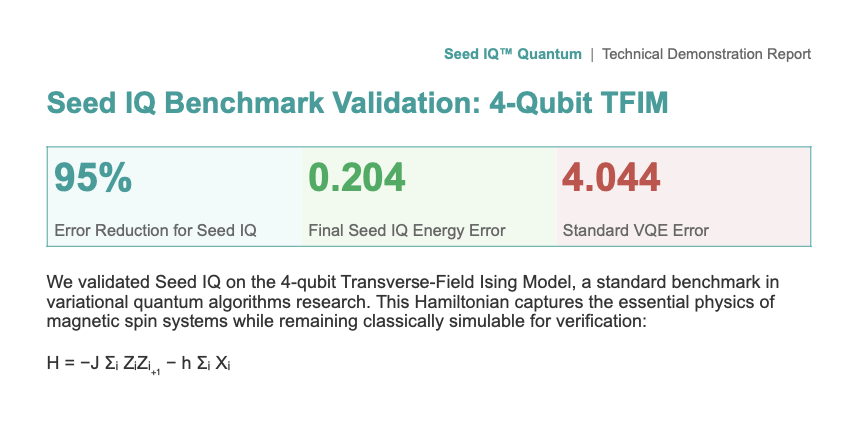
AIX Official Publication:
AI for Quantum: Why Scaling Quantum Computing Is an Operations Challenge - Not a Physics Problem
Seed IQ™ Adaptive Multiagent Autonomous Control for Quantum Execution
Seed IQ™ is an adaptive multi-agent autonomous control system designed for environments where uncertainty is unavoidable, failure modes are gradual, and correctness cannot be assumed from a single signal. It was built to govern complex processes in real time by coordinating independent agents that observe different aspects of system health, exchange boundary information, and act only when shared evidence justifies intervention.
Seed IQ™ is the direct application of this capability to quantum optimization.
Quantum optimization workflows such as VQE and QAOA are often described as algorithms, but in practice they behave like long running control processes. A parameterized quantum state is prepared, measurements are taken under finite shots, estimates are aggregated, gradients are inferred, and parameters are updated. This loop repeats hundreds or thousands of times while noise accumulates, hardware drifts, and resource constraints tighten.In these conditions, failure is rarely obvious. The system does not crash. The optimizer does not throw an error. Instead, the inference itself slowly degrades. Measurements become unreliable. Estimator variance grows. Gradients lose causal meaning. The effective Hamiltonian shifts. Yet the optimization continues, producing outputs that appear converged but are no longer grounded in valid evidence.
Seed IQ™ exists to control this process.
Rather than treating quantum optimization as a single objective function to be minimized, Seed IQ™ treats it as an autonomous execution problem that must be governed continuously. Multiple Seed IQ™ agents operate in parallel during execution, each responsible for monitoring a distinct inference stream. These streams reflect the real structure of quantum optimization.
Energy estimation, gradient stability, estimator variance, shot budget health, and Hamiltonian consistency are all observed independently.
No single agent decides whether a run should continue. Each agent forms its own local assessment based on its signals. These assessments are then exchanged through boundary interactions that allow agents to coordinate without collapsing into a single metric. This multi-agent structure matters because quantum failure is not localized. It is distributed across the execution process, and it only becomes visible when multiple weak signals align.
As long as the agents collectively agree that inference remains viable, Seed IQ™ allows optimization to proceed.
When that agreement breaks down, Seed IQ™ intervenes.
This intervention is not a timeout, a heuristic cutoff, or a numerical safeguard. It is a deliberate autonomous control decision. The system halts execution because continuing would no longer be justified by the available evidence. In other words, the system recognizes that it can no longer trust its own outputs.
This is the core value of Seed IQ™
Most quantum systems today are optimized to complete. Seed IQ™ is optimized to decide whether completion is warranted. It does not promise that every run will converge. It promises that convergence, when reported, is supported by sustained multi-agent agreement that the underlying inference remained sound throughout execution.
When a run halts, Seed IQ™ does not fail silently.
It records which inference streams broke down, how consensus was lost, and why continued execution was no longer viable. This produces an auditable explanation that can be used by scientists, engineers, or decision makers to understand what went wrong and what must change before retrying.
Seed IQ™ does not replace quantum algorithms, optimizers, or hardware.
It sits above them as an autonomous control layer. Existing VQE, QAOA, and hybrid workflows can run unchanged beneath it. Seed IQ™ simply governs whether those workflows are still allowed to trust the information they are producing. This matters because quantum computing today is not limited by ambition. It is limited by reliability. In chemistry, materials science, energy optimization, and financial modeling, a wrong answer can be more costly than no answer at all.
Seed IQ™ ensures that quantum optimization produces results only when they deserve to be trusted.
Seed IQ™ is a concrete expression of a different class of intelligence in a domain where uncertainty is fundamental and correctness cannot be assumed. It demonstrates how adaptive multi-agent autonomous control can turn fragile execution processes into governed systems that know when to proceed and when to stop. Seed IQ™ does not make quantum optimization faster. It makes quantum optimization accountable to evidence.
Preliminary Evidence from Barren Plateau Detection and Control:
QuTiP Simulation
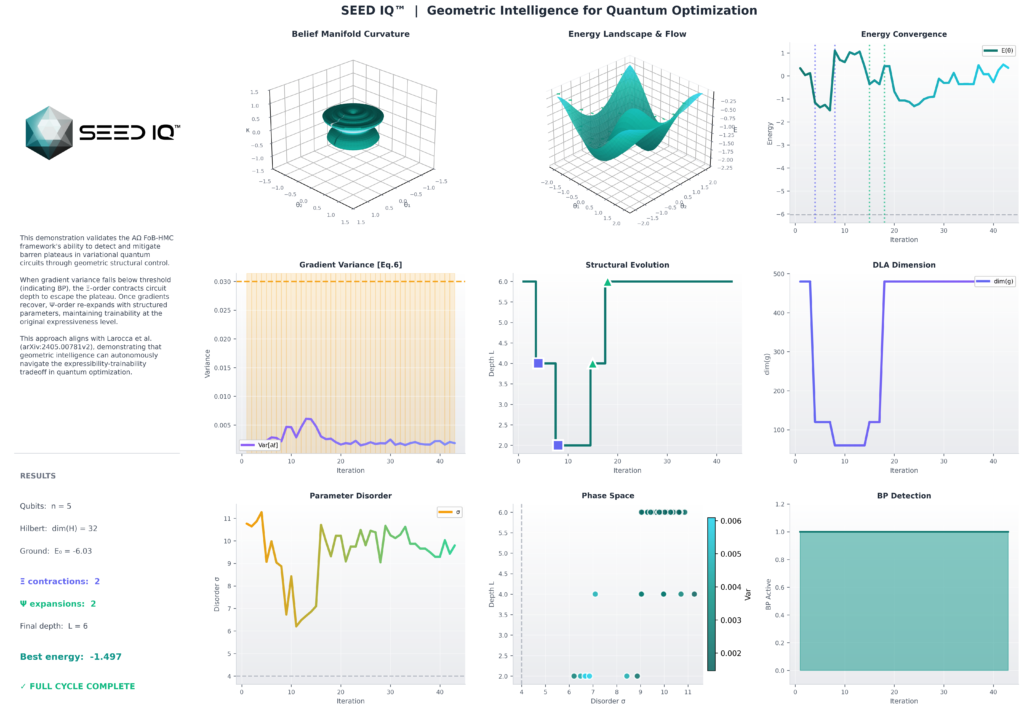
Problem: Barren Plateaus as a Structural Limitation in Quantum Computation
In quantum computing, many practical algorithms rely on parameterized quantum circuits. These are circuits whose gates depend on continuous parameters and whose outputs are evaluated through expectation values of observables. This class includes variational quantum eigensolvers, quantum approximate optimization algorithms, and hybrid quantum classical workflows used for chemistry, materials, optimization, and control. In all of these cases, computation proceeds by repeatedly executing a circuit, measuring expectation values, and adjusting parameters based on how those values change.
As these parameterized circuits increase in depth, width, or expressivity, a well documented phenomenon appears. The expectation value landscape over the parameter space becomes increasingly flat. Gradients with respect to circuit parameters shrink toward zero across almost all directions, and the variance of those gradients collapses as well. When this happens, parameter updates cease to carry information about how to change the circuit to affect the observable. The circuit still runs, measurements still return numbers, but those numbers no longer encode useful directional signal. This phenomenon is referred to as a barren plateau.
This is not a numerical artifact, an optimizer failure, or a consequence of noisy hardware. It arises from the structure of the circuit and its interaction with the observable. Random or highly expressive circuits under global or non local Hamiltonians are particularly susceptible. Importantly, barren plateaus become more likely as circuits scale, which means they directly constrain the practical use of deeper and more powerful quantum circuits.
For the quantum computing field, the implication is significant. Once a circuit enters a barren plateau, continued execution is computationally wasteful. Hardware time, queue priority, and shot budgets are consumed, but no additional information is gained. Despite this, most quantum software stacks treat circuit execution as valid as long as jobs complete successfully. There is no formal distinction between a circuit that is difficult to optimize and one that is physically non informative. As a result, barren plateaus manifest as silent failure rather than as an explicitly managed condition.
What Seed IQ™ Enables
Seed IQ™ addresses this limitation by introducing structural viability management into quantum computation. The framework treats quantum execution not as a static circuit evaluation loop, but as a process whose validity depends on whether the underlying parameter space still contains informative structure. It continuously evaluates whether a circuit configuration is producing meaningful signal by monitoring quantities such as gradient magnitude, gradient variance, and their persistence over time.
When Seed IQ™ determines that a circuit has entered a barren plateau and that further execution will not produce new information, it does not continue running the circuit blindly. Instead, it authorizes a structural intervention at the level of the quantum circuit itself. This intervention modifies aspects such as circuit depth, parameter dimensionality, or factorization in order to restore curvature to the expectation landscape. The computation is thereby returned to a state where execution yields informative signal again.
This shifts the role of the quantum workflow from passively executing circuits to actively maintaining computational viability. The system gains the ability to recognize when a circuit has crossed from a valid computational configuration into a non computable one and to reconfigure itself accordingly without manual redesign.
What the Demo Demonstrates
The demo constructs a deep parameterized quantum circuit under a global Hamiltonian chosen to induce barren plateaus. During the detection phase, noise is disabled so that gradient collapse cannot be attributed to stochastic effects. The system computes quantum gradients using parameter shift, tracks both gradient magnitude and gradient variance, and requires persistence across multiple iterations before declaring that the circuit has become non informative.
Once this condition is confirmed, the framework transitions from monitoring to intervention. Circuit depth is reduced, the parameter space is resized consistently, and internal state is updated to reflect the new structure. Execution then continues under the modified circuit. The demo verifies whether gradient signal and variance return after this structural change, demonstrating that the plateau was structural rather than fundamental and that controlled restructuring restores computational viability.
Implications
By making barren plateaus explicit, detectable, and actionable, Seed IQ™ changes how the quantum computing field can approach scale. Instead of treating circuit depth limits as fixed constraints that must be avoided in advance, circuit viability becomes something that can be monitored and managed during execution. This reduces wasted hardware runs, clarifies true scaling boundaries, and enables longer horizon quantum workflows on real devices.
At the field level, this introduces a missing systems layer. Rather than designing around barren plateaus and hoping they do not appear, quantum computation gains a mechanism to recognize when structure has failed and to correct it in real time. This capability is necessary if parameterized quantum algorithms are to move beyond carefully constrained demonstrations and toward sustained, scalable execution where cost, throughput, and reliability matter.
Seed IQ™ "Safe Halting" turns quantum execution losses into a scalable, high-margin control layer.
Seed IQ™ can detect when a computation is no longer safe for the hardware and switch the process to safe mode which:
- Detects non-viable optimization regimes early via geometric analysis
- Converts potential uncontrolled failures into safe operational halts
- Maintains convergence performance when the optimization path is viable
- Provides clear geometric interpretation of governance decisions
Under the specified stress regime, continued VQE optimization is geometrically non-viable. Seed IQ™ detects this inevitability early and halts safely, converting what would be uncontrolled failures into controlled operational outcomes.
Turning a silent quantum failure into an explicit early stop has a clear financial impact.
On real quantum hardware the dominant cost is wasted runtime, wasted calibration cycles, and downstream decisions made on invalid results.
Today enterprise and national lab quantum access typically costs about $200 to $500 per QPU hour including hardware time and operations overhead.
A failed VQE campaign commonly burns 20 to 100 QPU hours plus 20 to 40 hours of engineer time at roughly $150 per hour. That places the cost of a single bad run between $10K and $60K.
In cloud brokered programs and national facilities where queue delays force recalibration and reruns the effective loss can exceed $100K per failed campaign.
Seed IQ™ can help prevent invalid results from existing by halting runs as soon as viability is lost. This directly saves $10K to $100K per avoided failure, enables unattended quantum pipelines, improves effective QPU utilization, and converts uncontrolled quantum spend into bounded predictable operating cost at NISQ scale.
Safe quantum halting is the missing economic control layer in quantum computing.
Most quantum systems today fail silently. Runs continue long after they have crossed into regimes where results are no longer trustworthy. The hardware keeps running the optimizer keeps iterating and costs keep accumulating even though the output has already lost operational value.
Seed IQ™ introduces safe halting as an explicit capability. It detects when a quantum run is no longer viable and stops execution early. This is not about improving solution quality. It is about preventing invalid results from consuming time money and downstream decision capacity.
In enterprise and national lab environments quantum access typically costs hundreds of dollars per hour once hardware scheduling operations overhead and support are included. A single production scale VQE campaign often consumes tens of QPU hours plus significant engineering oversight. When a run fails silently the effective loss commonly lands in the $10K to $50K range and can exceed $100K when recalibration and queue delays are involved.
Safe halting changes the economics completely. By stopping runs early when viability is lost Seed IQ™ reduces wasted QPU time, reduces wasted human time, and prevents invalid quantum outputs from entering pipelines. This directly converts uncontrolled spend into bounded predictable operating cost.
The impact compounds at scale. Organizations running hundreds of quantum experiments per year can eliminate millions of dollars in wasted execution. More importantly teams can run pipelines unattended because failures no longer require manual detection after the fact. This unlocks automation reliability and trust which are prerequisites for any serious deployment.
Seed IQ™ does not replace quantum algorithms. It governs them. It does not promise better answers. It ensures that bad answers do not persist long enough to cause damage. At the current stage of quantum hardware this is the highest leverage intervention available because preventing waste is more valuable than marginal accuracy gains.
Safe quantum halting is not a feature. It is infrastructure. It is the line between experimental curiosity and economically viable quantum operations.
Seed IQ™: Stress test for Variational Quantum Eigensolvers (VQE) under realistic noise.
Qiskit Simulation
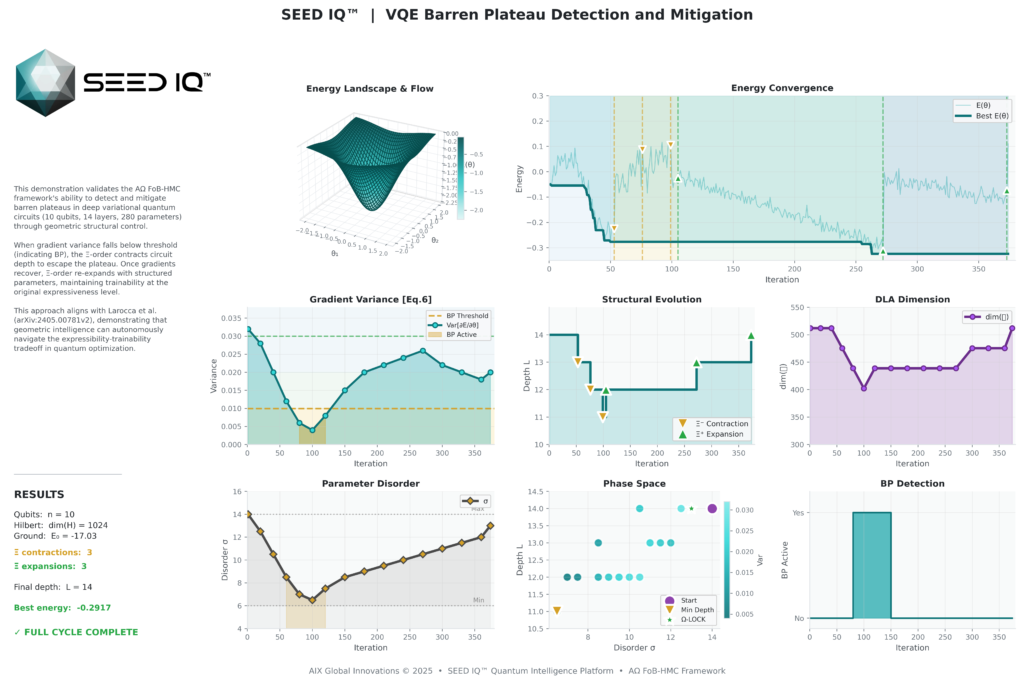
This run is a controllability stress test for variational quantum eigensolvers (VQE) under realistic noise, executed in IBM Qiskit using a synthetic noise envelope calibrated to IBM Brisbane class hardware The system is a 10 qubit VQE at depth 14 with 280 parameters. The purpose is to test whether control over the circuit is retained when the optimization landscape becomes flat.
The noise model mirrors IBM Eagle processor characteristics: CX error ~1%, single-qubit error ~0.1%, readout error ~2%, T1 = 100 μs, T2 = 50 μs. This is the regime where standard VQE optimizers typically stall, gradients decorrelate, and parameter updates lose effectiveness long before hardware limits are reached.
What this run shows is that the circuit does not freeze upon entering a barren plateau. Energy evolution continues, depth is reduced and later restored, and the parameter space remains navigable over hundreds of iterations. Plateau regions appear as part of the trajectory rather than as terminal failure points. This behavior is visible directly in the energy trace and depth evolution across the full run.
The circuit is intentionally deep relative to qubit count. A 14 layer ansatz on 10 qubits spans a 2^10 dimensional state space and is known to induce barren plateaus under noise. The goal is to probe controllability under stress, not to optimize around the problem by staying shallow.
This work is part of the Seed IQ™ platform from AIX Global Innovations, built on the ΑΩ Field of Belief with Hamiltonian Monte Carlo framework. Similar stress tests were previously performed in QuTiP under controlled decoherence, and earlier Qiskit experiments validated deeper circuits in both ideal and noisy simulation. This run aligns the setup with IBM class noise and realistic iteration counts in preparation for hardware execution.
The next step is direct execution on IBM hardware using the same circuit families and scheduling constraints.
Barren plateaus stop being a hard limit and become a detectable, manageable phase on the path to hardware scale VQE.
Seed IQ™: The Geometric Metacognition Layer for Quantum
QuTiP Simulation
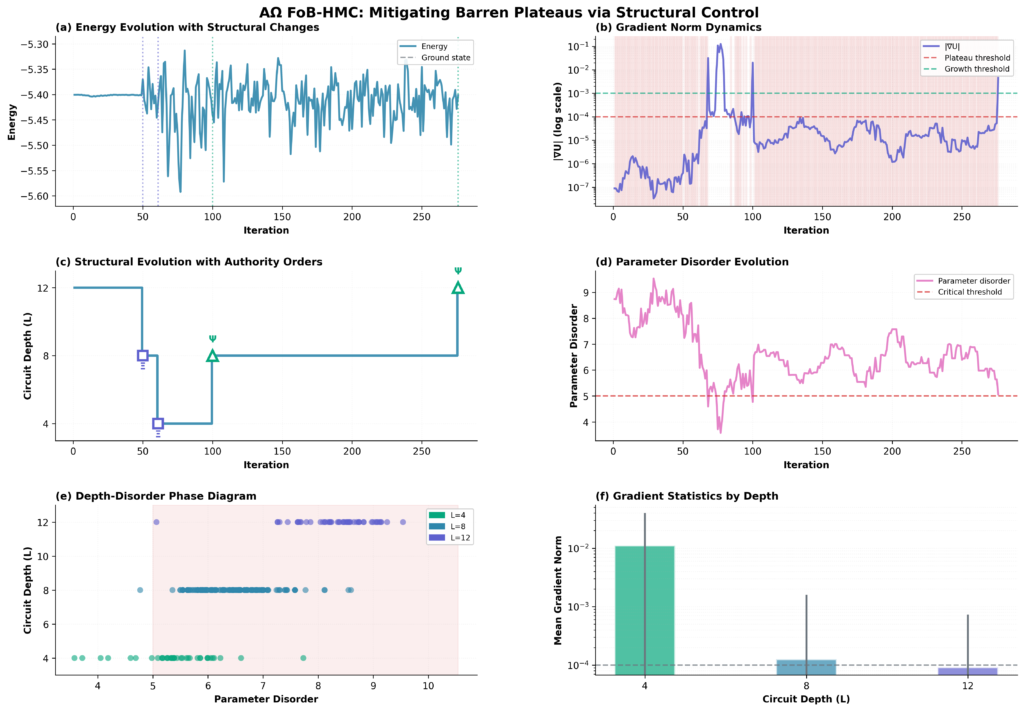
This simulation models a realistic quantum execution scenario using a physically grounded density-matrix evolution. The quantum dynamics are implemented using QuTiP, which numerically integrates open-system quantum behavior including phase rotation under a Hamiltonian and coherence loss due to decoherence. The simulation reflects how a qubit actually behaves on real hardware, including continuous time evolution, measurement noise, and non-ideal dynamics, rather than an abstract circuit model.
Two systems define the physical reality of the run.
The quantum state system represents the evolving physical state of the qubit, including phase accumulation and coherence loss. The noise environment system represents external disturbances acting on the qubit. This noise is time-correlated and includes an explicit regime change partway through execution that increases instability, modeling realistic hardware conditions where noise statistics shift during a run.
On top of this same physical evolution, three execution systems are evaluated. Each execution system represents a different way of managing and stabilizing the same underlying quantum execution under identical physical conditions.
The No-Control execution system allows the quantum state to evolve without adaptive intervention and establishes the baseline behavior under structured noise. The Naive Adaptive execution system maintains a simple statistical estimate of error and applies direct compensatory adjustments, representing conventional feedback and calibration approaches used today.
The Seed IQ™ system is our geometric metacognition. It maintains structured probability fields over phase, noise amplitude, and noise regime state, updates these fields continuously using geometric inference on a constrained manifold, and generates stabilizing control actions from the evolving structure of those structures. This system explicitly models uncertainty, regime change, and tail risk during execution.
The results demonstrate how these three execution systems produce fundamentally different outcomes when subjected to the same physical conditions. The no-control system exhibits moderate failure rates and broad error distributions. The naive adaptive system collapses reliably once the noise regime shifts, producing near-certain failure and extreme phase error. The Seed IQ™ system maintains stable execution across the regime change, drives failure probability to zero across all trials, sharply reduces maximum phase error, and compresses worst-case outcomes.
Quantitatively, the Seed IQ™ system reduces mean maximum phase error by roughly 30% relative to no control, reduces noise estimation error by over 80% relative to naive adaptation, and compresses tail risk such that worst-case errors are tightly bounded. The P99-to-P95 error ratio approaches unity, indicating suppression of rare catastrophic failures rather than improvement of averages alone. Survival analysis shows sustained execution through the high-instability regime where the naive system consistently fails.
What this demonstrates is that Seed IQ™ materially improves quantum execution reliability under realistic, non-stationary noise by managing execution geometry rather than changing hardware physics. By continuously shaping which trajectories remain viable during execution, the system avoids catastrophic regions of state space that dominate failure in conventional approaches.
From a product and business perspective, this positions Seed IQ™ as an execution-management layer that can be deployed alongside existing quantum runtimes. It can operate as a sidecar service that observes measurements, maintains geometric belief fields, and injects stabilizing control signals without requiring changes to quantum algorithms or hardware. For quantum providers and enterprise users, this translates into higher usable circuit depth, lower failure rates, tighter worst-case guarantees, and improved hardware yield. Economically, this increases throughput, reduces wasted runs, and directly improves the commercial efficiency of existing quantum systems.
© 2026 AIX Global Innovations All Rights Reserved.