

AUTONOMOUS WAREHOUSE
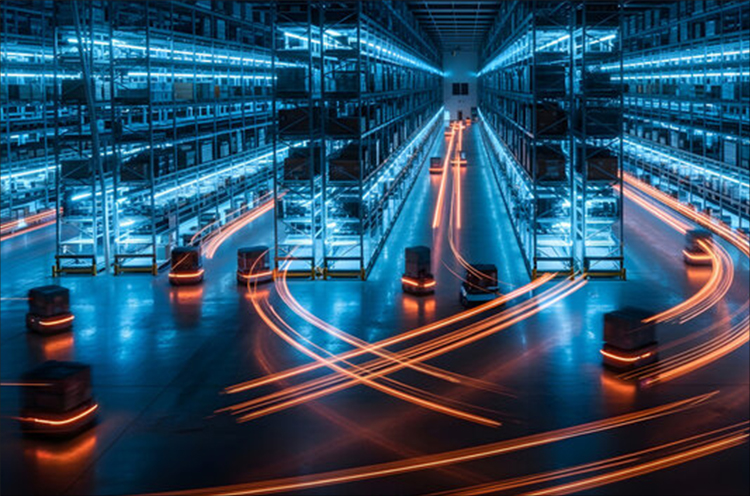
Fully Autonomous Warehouses
Require a Different Kind of Intelligence
Seed IQ™ enables real-time, collision-free coordination across
multiple autonomous agents operating under shared constraints.
Modern logistics and supply chain operations are dynamic, high-throughput environments where small coordination failures cascade quickly into delays, safety incidents, and financial loss. Warehouses operate under constant motion: vehicles, people, inventory, and schedules all interact in real time. Traditional automation struggles in these settings because it treats decision-making, perception, and coordination as separate problems, often requiring rigid rules, centralized control, or frequent human intervention.
Seed IQ™ introduces a different model for autonomy in logistics. Rather than optimizing individual agents in isolation, Seed IQ™ governs the entire operational environment as a coherent system. Each agent operates with bounded autonomy, aware of its role, constraints, and objectives, while continuously sensing and adapting to the shared space around it. Coordination is not imposed through scripts or centralized orchestration. It emerges naturally as agents align their actions with global operational goals in real time.
In autonomous warehouse demonstrations, multiple agents navigate simultaneously while loading and unloading delivery trucks, avoiding obstacles, and responding to human presence without collisions. Even as complexity increases, agents remain stable, responsive, and productive. Tasks continue uninterrupted, paths adjust dynamically, and safety is preserved without pausing the system or escalating control to human supervisors.
This level of multi-agent coordination is not achieved through training on massive datasets or hard-coded behaviors. Seed IQ™ does not rely on predefined traffic rules, static maps, or brittle policies. It continuously infers system state, evaluates viability, and adapts actions moment by moment. Each agent remains autonomous, yet the system behaves as a unified whole.
The financial implications are significant. Collision avoidance, throughput optimization, and unattended operation directly reduce labor costs, downtime, damage, and insurance exposure. At scale, Seed IQ™ transforms warehouses from cost centers constrained by coordination risk into continuously optimized, capital-efficient assets. This represents a scalable control layer that can be deployed across logistics networks without retraining, reconfiguration, or escalating operational overhead.
Adaptive Multi-Agent Autonomous Navigation - Zero Collision
Demo 1
This demonstration shows Seed IQ™ coordinating from one to eight autonomous agents as they solve 33 navigation problems, including 12 highly complex scenarios involving crisscrossing paths, position swaps, tight corridors, and shared targets. Agents operate with limited local sensing, similar to real-world lidar or vision constraints, and no agent has access to a global map or predefined route.
Despite these constraints, agents dynamically coordinate in real time. Paths adjust continuously, conflicts resolve without intervention, and zero collisions occur across all tested scenarios. Even in situations where multiple agents must pass through the same narrow space or swap positions simultaneously, coordination emerges smoothly rather than being enforced through rules or centralized control.
What this demo illustrates is not path planning in the traditional sense. There is no training phase, no learned policy, and no stored navigation playbook. Seed IQ™ infers the geometry of the shared environment as it unfolds, allowing agents to remain uncertain, negotiate space implicitly, and converge on safe trajectories together. As complexity increases, performance remains stable rather than degrading.
This capability directly addresses a long-standing failure mode in autonomous systems, where scaling the number of agents or the complexity of the environment causes learned behaviors to break down. Seed IQ™ demonstrates that multi-agent autonomy can remain robust without retraining or reconfiguration, even as scenarios become denser and more adversarial.
Seed IQ™ Autonomous Warehouse Coordination
Demo 2
Every forklift servicing incoming trucks with pallets is an instance of Alpha Omega FoB HMC geometric metacognition agent. All operating as part of the same intelligence field.
No central loop or central controller is present – only a dashboard collecting and merging stats across the fleet. Agents cooperate based on sensing the world and building their local world model. Silent consensus emerges based on shared geometry and operational constraints being broadcast by each agent (UDP, radio or visual signal).
No symbolic or direct messages are ever exchanged.
This demo shows Seed IQ™ operating a live warehouse environment using an adaptive multi-agent autonomous control engine – ΑΩ FoB HMC.
What you are seeing on the screen is not a script.. It is a live control system running continuously against a warehouse facility. Inbound trucks arrive at docks and inject work into the system in real time. Inventory enters the floor. Pickup, approach, and drop tasks are created dynamically as pallets move into circulation. Agents are not assigned routes or schedules ahead of time. They are only instantiated with objectives and priors and released into a shared operating wilderness.
Forklifts move through narrow aisles at speed. Multiple agents converge on the same corridors. Intersections fill quickly. Tasks overlap. Humans and AMRs operate in the same environment, introducing motion that cannot be predicted or scripted. This is exactly the operating regime where traditional warehouse automation systems fail.
There is no global controller coordinating this behavior. There is no central planner computing paths. There are no reservation tables, priority graphs, or conflict rules embedded in the system. Every agent is governed by the same Seed IQ™ control engine and reasons only over its immediate surroundings. Coordination is not negotiated, scheduled, or enforced externally. It emerges continuously from interaction.
Each agent maintains and evolves a local world model over how to move next, shaped by task pressure, physical constraints, safety budgets, and the presence of other agents, humans or robots. That world model evolves continuously under control dynamics. Motion is the result of that evolution, not the execution of some plan. When conditions change, behavior adapts immediately, without replanning or centralized intervention or model retrain.
This is why collisions do not occur, even as speed increases significantly and traffic density rises. Safety is not enforced by rules layered on top of motion. It is enforced as a hard viability constraint inside the control engine itself. When congestion builds, yielding and lane formation emerge without explicit coordination. When local bottlenecks emerge, structure is corrected without stopping the system or throughput.
As more agents are introduced, complexity does not grow combinatorially. Each agent remains bounded in what it needs to reason about. There is no explosion in coordination cost. The warehouse remains operational inside a stable bounded autonomy envelope, even as humans, AMRs, and additional forklifts increase interaction pressure.
This demo shows that warehouse autonomy does not necessarily require predicting every interaction. It requires a control engine that can adapt continuously, enforce viability, and remain stable as complexity increases.
Agents sense when vehicles arrive, allocate tasks among themselves, and adapt paths in real time while avoiding collisions with each other, infrastructure, and people. Work continues uninterrupted as conditions change. No centralized scheduler micromanages movements, and no agent follows a fixed script. Coordination emerges continuously as part of the system’s operation.
This behavior is fundamentally different from warehouse robotics systems built on deep learning or rule-based automation. There are no predefined traffic rules, static maps, or retraining cycles when layouts or workflows change. Seed IQ™ governs execution rather than predicting outcomes, allowing agents to remain responsive and viable even as the environment shifts.
The significance of this demo is operational. It shows that fully autonomous dark warehouse scenarios are achievable without fragile control systems or constant human supervision. For logistics and supply chain operations, this enables higher throughput, safer environments, reduced downtime, and lower operating costs. It demonstrates a scalable autonomy layer that can be deployed across facilities and workflows without the exponential cost growth associated with training-heavy AI systems.
Why This Is Different from Warehouse Robotics Today
Most warehouse robotics systems are built around prediction and control. They rely on pre-trained models, fixed maps, centralized schedulers, or hand-coded traffic rules to coordinate movement. These systems can perform well in controlled conditions, but they struggle as environments become denser, more dynamic, or less predictable. Changes in layout, workflow, or traffic patterns often require retraining, reconfiguration, or human intervention to restore stability.
Seed IQ™ operates on a different principle. It does not attempt to predict every outcome or optimize isolated behaviors. It governs execution in real time by continuously inferring system state and preserving coherence across all agents operating in the environment. Each agent maintains bounded autonomy, yet remains aligned with shared operational constraints without relying on scripts or centralized oversight.
This distinction becomes critical at scale. Traditional robotics systems degrade as the number of agents increases or as interactions grow more complex. Coordination overhead rises, collision risk increases, and operational fragility sets in. Seed IQ™ maintains stability under these conditions, allowing additional agents, new tasks, and changing layouts to be absorbed without retraining or loss of performance.
The result is a form of autonomous operation that is viable for real-world logistics, not just controlled demos. Warehouses can operate continuously, adapt instantly to disruptions, and scale throughput without proportional increases in cost or complexity. For operators, this reduces downtime, labor dependency, and safety risk. For investors, it represents a defensible, high-leverage intelligence layer capable of transforming logistics and supply chains into fully autonomous, capital-efficient systems.
© 2026 AIX Global Innovations All Rights Reserved.