

ARC AGI BENCHMARK
ARC AGI Benchmarks Reveal
What Intelligence Actually Requires
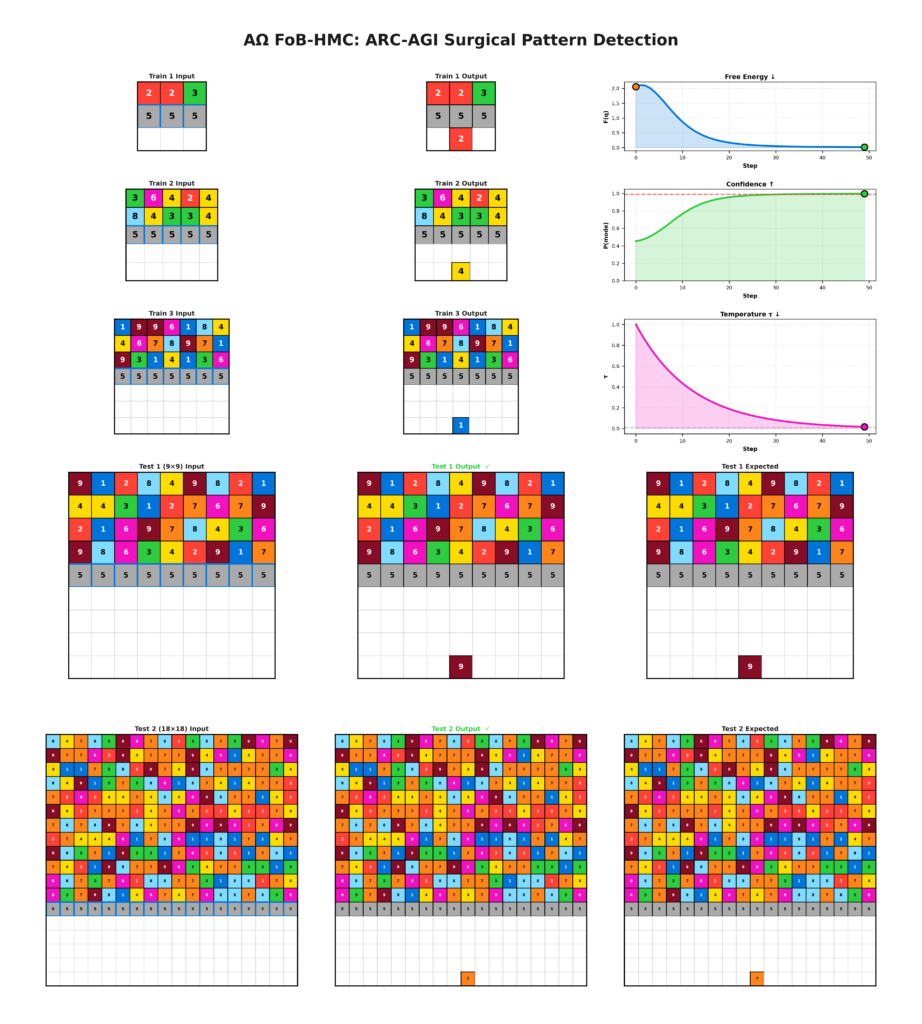
Seed IQ™Running on the ΑΩ FoB HMC Engine Solves Simulated ARC AGI Benchmarks through Structural Inference, Not Training, Pattern Matching, or Search.
The ARC AGI benchmark was designed to expose the limits of contemporary AI systems. It intentionally removes scale advantages, training distributions, and task-specific cues. Each problem provides only a handful of examples, no instructions, and no reward signal. Success requires the ability to infer structure, recognize global invariants, and generalize correctly under extreme data scarcity.
ARC AGI does not measure how well a system recognizes patterns it has already seen. It measures whether a system can discover what matters when nothing is labeled, nothing is explained, and nothing can be memorized.
Most deep learning systems approach ARC AGI as a learning problem. They rely on pretraining across massive datasets, statistical correlations, and pattern completion. When applied to ARC-style tasks, these systems attempt to interpolate from prior experience or overfit to surface regularities in the provided examples. In small or familiar regimes this can appear to work. As task geometry becomes irregular, scale changes, or structure departs from learned distributions, performance degrades sharply. Failures are not random. They are structural.
The core limitation is not compute or model size. It is representation. Deep learning models do not natively reason over global structure. They approximate it statistically, which makes correctness unstable when conditions shift.
Seed IQ takes a fundamentally different approach.
Seed IQ does not learn ARC tasks. It infers them.
Rather than mapping inputs to outputs through trained weights, Seed IQ represents each problem as a continuous belief field constrained by structure. Multiple hypotheses coexist simultaneously. No symbolic rules are enumerated. No traversal or search is performed. No decision is forced until the global configuration becomes coherent.
In enclosure tasks, interior and exterior are not labeled or computed procedurally. They emerge as the only stable configuration that satisfies boundary constraints. In periodic extension tasks, patterns are not memorized or extrapolated statistically. The underlying generator is inferred and enforced uniformly across scale. In all cases, solutions arise through convergence, not prediction.
This process requires no pretraining, no domain-specific tuning, and no task-specific operators. The same inference dynamics apply regardless of grid size, geometry, or complexity. Scale increases resolution, not difficulty.
What ARC AGI reveals is not that intelligence is hard to train, but that intelligence cannot be reduced to training alone. It requires systems that can remain uncertain, represent competing explanations, and allow structure to resolve belief rather than forcing premature decisions.
Because Seed IQ is not learning these tasks from examples but reasoning them through in real time, increasing the size or complexity of a problem does not change how it performs. Where other AI systems break down as tasks scale beyond what they have seen before, Seed IQ continues to solve the problem as a whole and converges on the correct solution just as quickly.
This matters commercially because it means Seed IQ can be deployed across new, larger, and more complex problem spaces without retraining, revalidation, or escalating operating costs, enabling scalable, capital-efficient deployment across industries.
Seed IQ demonstrates that this class of intelligence is not theoretical. It is operational.
And the implications extend far beyond benchmarks. ARC AGI is simply where the difference becomes impossible to ignore.
ARC AGI Evaluation Methodology
Seed IQ™ is evaluated using an ARC AGI–compliant simulator that generates novel tasks dynamically at runtime. Each test is created fresh, with no reuse, memorization, or exposure to a fixed dataset of ARC problems. The simulator follows the same constraints, formats, and rules defined by the ARC AGI benchmark, including minimal examples, zero instructions, and strict generalization requirements.
This evaluation setup ensures that Seed IQ™ is not learning ARC tasks from prior exposure. Every problem is encountered for the first time at execution. Performance reflects inference capability rather than familiarity with task distributions, benchmark leakage, or adaptive fine-tuning.
Seed IQ’s approach to ARC AGI benchmarks differs fundamentally from other AI systems currently applied to these problems. Most contenders rely on some combination of pretraining, task exposure, statistical pattern interpolation, symbolic rule enumeration, or search-based procedures. Even when such systems succeed on individual tasks, correctness depends on learned distributions, handcrafted operators, or computationally expensive exploration that becomes unstable as task structure or scale changes.
Seed IQ™ does none of these. It does not train on ARC tasks, enumerate rules, or search solution space. Each task is represented as a continuous belief field in which multiple structural hypotheses coexist. Inference proceeds through convergence toward a globally coherent configuration rather than stepwise execution of predefined operations.
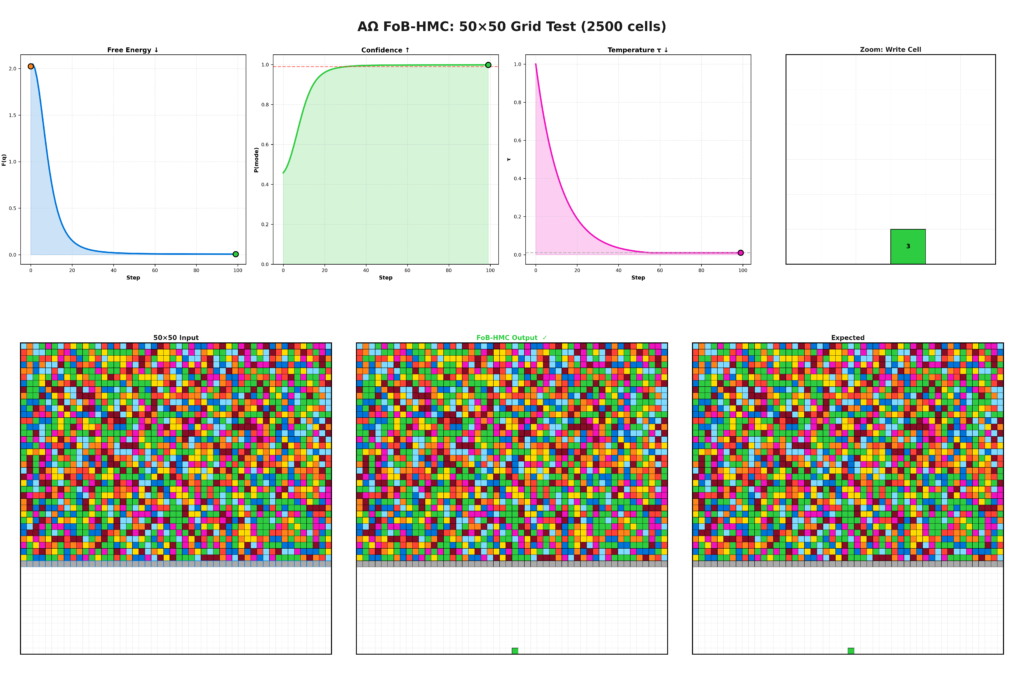
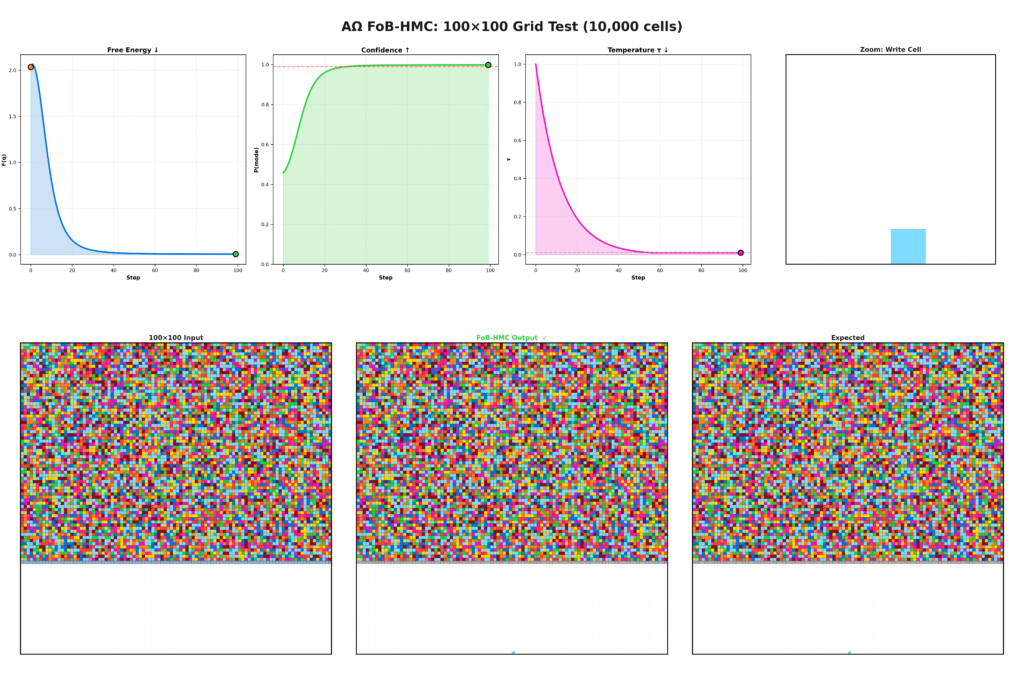
This inference process remains stable as tasks scale. Larger grids or more complex geometries do not push Seed IQ™ outside a learned distribution of solutions. The system continues to evaluate the problem as a whole, leaving solution possibilities open until structural consistency resolves them by collapsing onto the answer. Execution time remains predictable, and solution quality remains invariant as scale increases.
This methodology provides a reliable picture of how Seed IQ™ performs under the same conditions imposed by the real ARC AGI benchmark. Results reflect structural inference capability rather than training advantage, benchmark familiarity, or dataset-dependent optimization.
Seed IQ™ and the ARC AGI Periodic Extension
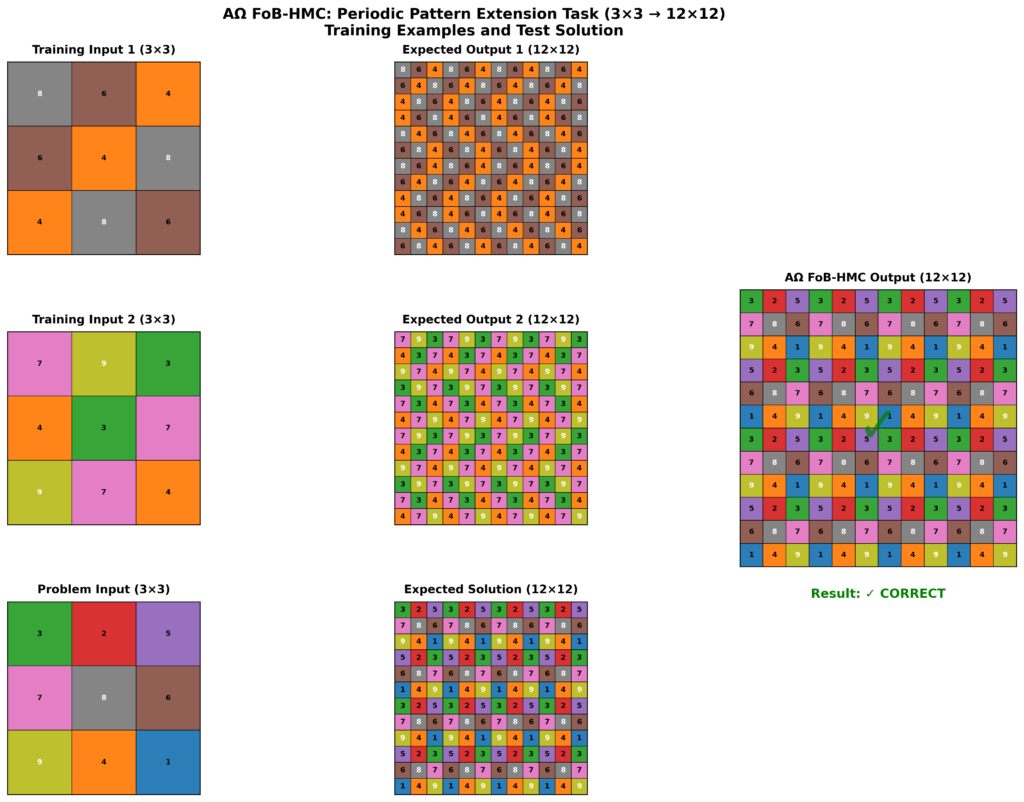
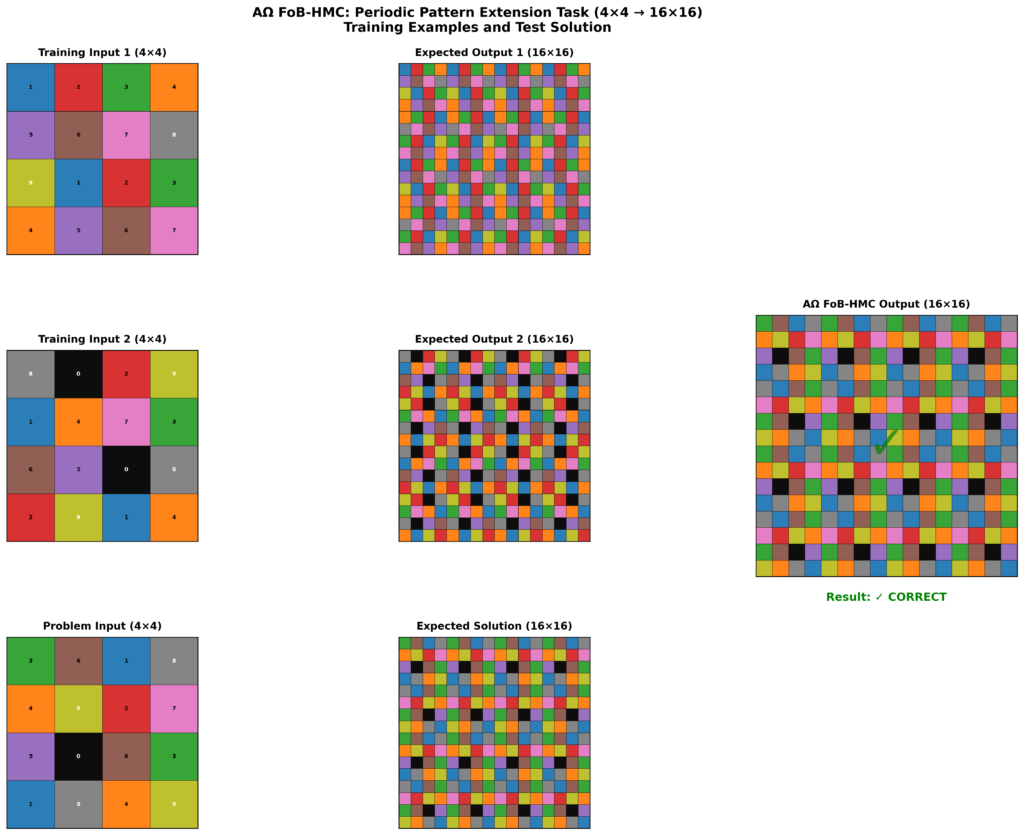
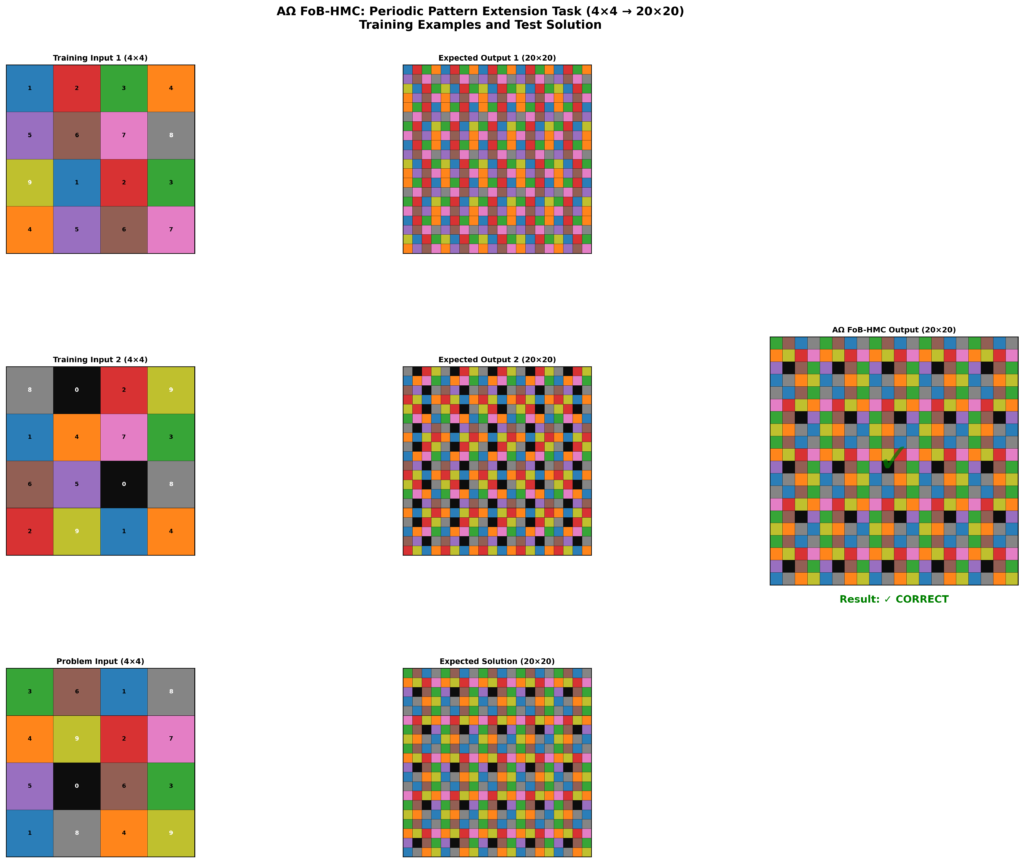
This is an ARC AGI task that looks trivial until you increase the scale.
The input is a small grid. The output is a large grid. The rule is periodic extension. Nothing exotic. No hidden symbols. No tricks. Just recognize and extend the pattern cleanly across space.
Humans glance at the initial test input grid and immediately see it.. We do not compute it. We do not enumerate pixels or implied rules. We do not simulate outcomes. We recognize structure and project it. The moment periodicity is visually obvious, the answer is clear instantly.
This task falls under ARC periodic pattern extension and tiling. It belongs to a class of problems where the correct output is not a transformation but a continuation of a spatial invariant. The grid is not data. It is a generator.
As the scale of the output grows larger and the tiling becomes denser, there is a point where this stops being easy to consciously follow, even for humans. You can still tell the pattern is periodic, but tracking the generator step by step becomes unreliable. The structure is still fully determining, but perceptual tracking breaks down. Extension remains trivial in principle, but no longer trivial in practice.
Now look at what happens with standard deep learning systems.
Yes, some DL models and LLMs will solve tasks like this. Especially those overfit on ARC style examples. That part can work.. But they are doing this by overfitting on samples and then pattern matching over expected sizes, alignments, and phases, not actually recognizing(!) a generator.
And that matters..
Because nothing in those systems guarantees correctness as scale changes arbitrarily. A small extension might work. A larger one might still work. But push the grid size far enough and errors do appear. Phase begins to drift.. The issue is not even that the pattern becomes harder. The issue is that the representation is not scale invariant.
DL systems learn periodicity statistically. They encode it at fixed resolutions, fixed receptive fields, and fixed training distributions. As size increases, approximation error accumulates.
What Seed IQ™ does here is different.
It infers a rule by instantiating a belief field over spatial hypotheses and lets the geometry settle into the only possible solution.. Periodicity is not remembered. It is enforced.. Scale does not add complexity because the same constraints apply everywhere at every scale. A small input and an arbitrarily large output are derived using the same learned attractor.
That is why the result remains exact. Humans lose perceptual traction as scale increases. Deep learning systems lose invariance.
Seed IQ™ system does neither.
The hard part is not even extending the pattern.. The hard part is knowing that extension is the only admissible move in this configuration.
And that is the difference between intelligence and pattern matching.
ARC AGI Task 1
Periodic Pattern Extension Problem
Applying Seed IQ™ to the Task
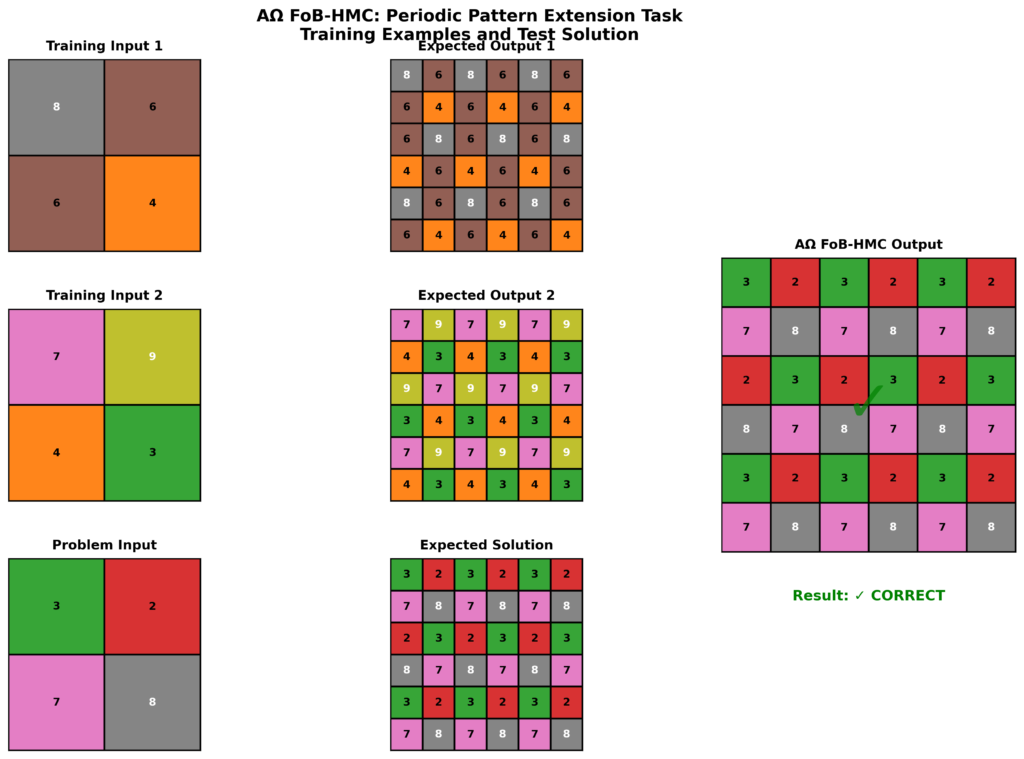
This ARC AGI task is a periodic pattern extension problem drawn directly from the dataset. The input is a 2×2 grid and the output is a 6×6 grid. The transformation requires tiling the input into a 3×3 layout while enforcing a row-wise alternating structural rule. The pattern is not simple repetition. Each row alternates between two structural phases derived from the original motif. Only two training examples are provided. There is no statistical distribution to learn from and no opportunity for memorization. The system must infer the underlying generative rule itself and apply it exactly to a novel input.
In ARC AGI terms this is a low to medium difficulty relational abstraction task. Humans usually solve it quickly once the alternation is perceived. AI can struggle because the solution depends on global structure rather than local pixel correlations.
Why this is hard for machines but moderate for humans
Humans reason over structure and can hold multiple interpretations of a pattern at once, delaying commitment until the global rule becomes clear. In this task the key insight is recognizing row wise alternation rather than simple tiling. Most AI systems fail because the task has zero pre-training and minimal data. Two examples are insufficient to learn a pixel level input output mapping, causing neural models to overfit surface features or produce visually plausible but structurally invalid outputs.
Symbolic systems can solve the task by enumerating candidate rules, but this relies on fragile and computationally expensive search. The core difficulty is maintaining multiple competing structural hypotheses without committing too early, something most systems cannot do without brute force.
How Seed IQ™ solves the task
Seed IQ™ represents the grid as a continuous field of interacting beliefs rather than fixed symbolic assignments. Each tile maintains a probability distribution over valid structural states, allowing multiple interpretations to coexist during inference. During field dynamics coherence is enforced within rows and alternation is enforced between rows, but no discrete decision is forced while ambiguity remains. The prolonged near 50/50 belief states reflect a structural configuration rather than simply uncertainty, analogous to quantum superposition constrained by the system’s energy landscape.
Only once the belief field becomes globally consistent does a higher authority order forces ‘collapse’ to solution state to occur. Each row commits to a single structural phase and boundary synchronization propagates this resolution across the grid. The final 6×6 output emerges because all incompatible configurations (trajectories) have become ‘energetically’ (mathematically) inaccessible.
Seed IQ™ solution time: 15 seconds
What this demonstrates
This example demonstrates that ARC AGI tasks can be solved without pre-training, brute force search, or hand coded rule enumeration.
The Seed IQ™ system does not learn a pixel mapping and does not guess among predefined operators.
It shows that abstraction can emerge from continuous geometric inference where multiple hypotheses coexist and are resolved only when global system awareness demands it. Discrete structure appears only after system wide coherence is achieved.
ARC AGI Task 2
Canonical Enclosure Task
Seed IQ™ and the ARC AGI Canonical Enclosure Task
This is an ARC AGI enclosure task that often gets misread as a traversal or flood fill problem.
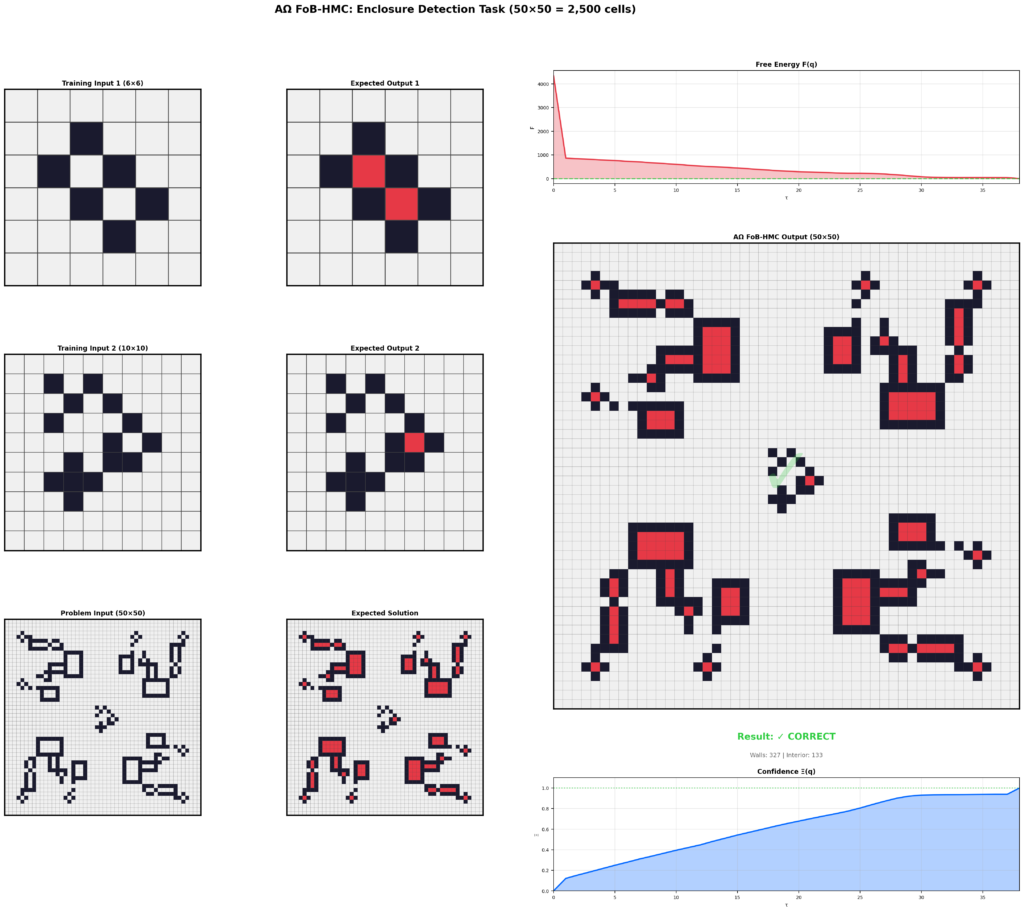
The input is a grid with walls and empty space. The output marks interior regions while leaving exterior regions unchanged. Nothing in the task description tells you how to do this. There is no notion of inside or outside encoded locally. The distinction only exists at the level of the whole structure.
Humans typically resolve this immediately. We do not simulate paths or predict pixel by pixel.. We recognize the full enclosure instantly. The answer presents itself as a property of the layout, not as the result of an operation or symbolic reasoning.
This task belongs to the ARC enclosure family, where the solution is determined by a global invariant. Whether a region is interior is not a function of proximity, density, or shape. It is a function of global and local topology.
At smaller layouts, this feels obvious. As the geometry becomes more irregular, branching, or nested, perceptual certainty degrades. The structure still fully determines the result.
Standard AI/deep learning systems approach this differently.
They can sometimes solve enclosure tasks, especially when trained or overfit on similar patterns.. They learn associations between wall configurations and filled regions. In familiar regimes this can solve it convincingly. But correctness is not stable when scale changes.
Alter the shape or scale. Add thin connections. Introduce unusual cavities. At some point, the learned behavior breaks. Regions that should remain exterior get filled. Regions that are enclosed get missed. The failure is structural rather than accidental.
What is happening here though is not linear search and it is not pattern matching.
The enclosure is resolved through free energy. Interior and exterior are not labeled because they are found. They are resolved because only one configuration minimizes free energy given the global constraints imposed by the walls and the boundary. The correct solution is the one local minimum the field can settle into without contradiction given constraints.
That is why scale does not introduce new difficulty for Seed IQ™.
With Seed IQ™ the same free energy landscape governs a small grid and a large one. Increasing size changes resolution, not the nature of the inference. There is continuity in behavior.
The answer is not computed.
It is the only stable solution that exists.
And with Seed IQ™ there is zero pre-train.
Applying Seed IQ™ to the Task
Task description
This ARC AGI task is an enclosure inference problem. The input is a single grid with empty cells and wall cells arranged in irregular, asymmetric shapes. The goal is to fill only those empty cells that are fully enclosed by walls. There are no region labels and no rules provided. The geometry must be understood directly from the grid. For humans, the answer is visually immediate. For machines, it requires global structural reasoning.
Humans do not analyze enclosure step by step. We recognize it holistically. The concept of “inside” is perceptual, not procedural. Machines do not have this capacity by default. Most AI systems either rely on local pattern correlations or simulate connectivity using floodfill logic. Local features cannot capture enclosure. Hardcoded procedures do not generalize and fail under irregular geometry. Neural models cannot express reachability without explicit structural constraints. The real difficulty is resolving global topology from minimal, structure-only input without memorization or rules.
How Seed IQ™ solves the task
Seed IQ™ models the grid as a belief field where each empty cell holds a continuous probability of being exterior. No symbolic labels are assigned up front. The system begins with uncertainty and lets structure resolve it.
It does not run a graph traversal. It does not flood. Instead, it updates beliefs by minimizing free energy across the grid while respecting constraints. Wall cells contribute fixed values. Empty cells adjust over time to minimize inconsistency between local beliefs and global structure. Cells that have viable paths to the boundary remain high in exterior belief. Enclosed regions gradually lose that probability mass and converge to interior.
The system does not force a decision at any point. The field evolves smoothly. After several steps, beliefs separate sharply. The decision crystallization curve shows a binary phase transition where interior and exterior become linearly separated. In this case, the system settles in 11 steps. That is not symbolic search. That is geometric convergence.
What this demonstrates
This task shows that Seed IQ™ performs true topological inference using continuous field dynamics. There are no hardcoded rules, no training data, no procedural logic. The system reaches the same result as classical algorithms but does so by letting the solution emerge from energy minimization.
It does not need to define connectivity. It lets the field expose it. The belief state becomes separable only when the structure fully supports it. That transition happens cleanly, efficiently, and without ambiguity.
The final result matches the expected output exactly. No noise. Correct topology resolved through conserved geometric inference.
© 2026 AIX Global Innovations All Rights Reserved.